Transcription:
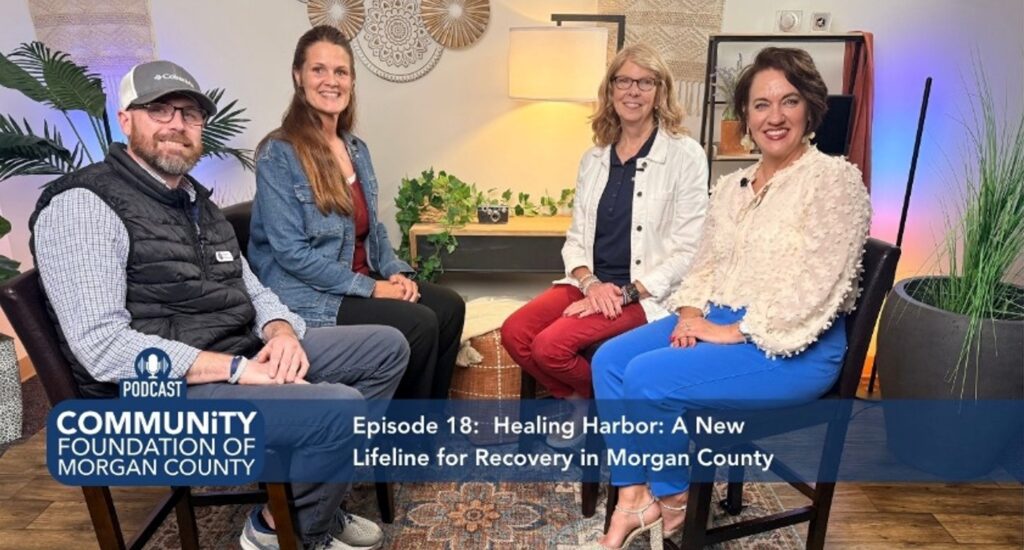
Kim Cole: Hi everyone, and thanks for watching. I’m Kim Cole, President of Community Foundation of Morgan County, and with me today, I have three guests from Stability First. I’m going to introduce them one at a time, but we’re going to start off with the Executive Director, Robin Wonnell.
Robin Wonnell: Thank you so much.
Kim: And Robin is a repeat guest here. If you’ve watched our podcast, you’ve seen her now, I guess, for a third time, and we keep having her back because there’s lots of exciting things going on with Stability First.
As most of you know, Stability First is a Morgan County nonprofit that provides transitional housing for those stepping out of recovery, stepping out of the penal system, and they get their lives together in this place. It is overwhelming, the programming and the results that they see. So, Robin, tell us about this new initiative because it’s really exciting.
Robin: It is, it is, and thank you so much for having us. Healing Harbor is a community-facing initiative of Stability First. We have the Foundations House and the Magdalene House, both 16 beds for men and women, and we serve our residents there with programming such as intensive outpatient treatment, financial literacy, budgeting, Bible studies, in all of the meetings and recovery programming that they need to continue to move forward and to grow in their recovery.
But what we want to do with Healing Harbor is serve the community and offer the resources and almost the things that we’re offering in our residences, in the houses, we want) to offer to the public. And so that’s what Healing Harbor will do.
Kim: Okay, and I know when we talked first about this, I loved how you just dreamed this up because of the need that was walking in the door, right?
Robin: That’s right, that’s right.
We had people at the time, we had people every day coming into our 210 West Morgan location, Stability First admin location, asking for help. Where can I find food, housing? Can someone give me some transportation? All of those things, ID, how do I get an ID? So, all of those things, and it was just the realization that we’re offering that here, why don’t we expand that so that the public knows? And I think it’s wonderful that, you know, when we think about it, it’s like you think, well, people are calling friends or family or whatever to answer these questions, but some people don’t have that. That’s right, they don’t. They come into the door with nothing or maybe a bag and all they own.
Kim: Yeah, right. Okay, so this opened roughly a month ago, correct?
Robin: It did. We received some grant funding back in October, but we have been all that time planning the opening, basically getting prepared, buying curricula that we’ll be offering there in classes, just that preparation for the grand opening.
Kim: Okay, so I want to introduce our other two guests that are very critical to Healing Harbor, and we have Dan Battistoni. Okay, I was practicing that and I knew it was going to fail. So, Dan, I met you at the gala, Stability First gala, last fall, and you had an incredibly moving speech about just your life and your life path. And it was profound because I felt like it was such a very normal story, and in how you ended up at Stability First and the blessings that you received there at Foundations House, if you could just do a brief recap, because the story is so good. I know that that night at the gala, there was not a dry eye in the house.
Dan Battistoni: Yeah, well, battled addiction for 15 years, come from a long line of it, and I happened to be in treatment in Indianapolis in December of 24. And I stayed there for 78 days and was on the verge of having to pay a lot of money to stay where I was or be homeless. And I found out about the Foundations House opening up in mere weeks from this point in time. I was 10 days away from having to pay a pretty substantial amount of money to stay where I was staying, and it really wasn’t very nice where I was at. So, it was a Godsend.
Kim: And Foundations House opened in February of 25.
Robin: February 25.
Dan: So, I was there the day it opened, and it’s hard to put to words, but what they did with me in such a short period of time is amazing, and I just can’t even imagine what it’s going to look like five years down the road from now.
Kim: And I’m assuming your experience there is what led to your now position with Healing Harbor. So, tell me what your position is.
Dan: So now I am the peer navigator at the Healing Harbor Recovery Engagement Center. We see all kinds of people that walk in the door. For me, I am a gap filler, dot connector. Whatever service they need or resource they need, I just try to connect them to that.
Kim: And help them figure it out. Yep. Okay.And then I’ll come back to you, Dan, but Leslie Gaw, new name. So, we’re practicing the new name. Congratulations on your recent nuptials.
Leslie Gaw: Thank you. You were also a resident at Magdalene House, so. I actually wasn’t a resident at Magdalene House. I was the director there.
Kim: Yes, ma’am. Okay. So, tell us your experience with Magdalene House, and tell us about your transition then to helping at Healing Harbor.
Leslie: I started at Magdalene House because I myself am in recovery, and so when I was ready to kind of start in a situation where Dan was to give back, I reached out to one of the former case managers there at Stability First. So, I actually started working there as the overnight person at Magdalene House, and then just kind of progressed. And so very recently the opportunity came up to move over to Healing Harbor, and definitely something that I wanted to do because as both of them have shared, we have these resources in our community. But when somebody is unsure about what’s happening, or they’re scared, or they’re alone, they’re not trying to go to several different places. And so just coming into the resource center and connecting with someone all in one spot, so we’re not replacing any of the services that we have. We’re just kind of connecting us all together in one location. So just being able, like Dan said, when you’re in panic mode and you need to go somewhere, we can bring someone in and sit them down, have a conversation with them, and hopefully connect them to the resources they need, whether it’s housing, food, transportation, mental health services, substance use disorder, or all of it at the same time. Or just general bad season in life. They just need somebody to listen, and so that’s kind of what we’re hoping for.
Kim: That’s awesome. So, you’ve all been open a few weeks now. So, tell us, how many people are you seeing? Is it increasing? Tell us about the clientele and the numbers you’re seeing.
Leslie: Well, it’s slowly increasing every day. We don’t have a lot of foot traffic just coming in with us, you know, being new. But as we continue to work with the service providers, get our name out there, let people know who we are. The majority of people in Morgan County know who Stability First is. Magdalene House grew over time, Foundations just in a year. A lot of folks know who Foundations is as soon as you say it. So hopefully over the next year, Healing Harbor will continue to grow that way. So, we have a few folks come in throughout the day, but a lot of people utilize our meeting times during the week.
Kim: What kind of meetings are you doing?
Dan: So, we offer AA, NA, life recovery. Coming up in June, we’re going to offer CRAFT, which is community reinforcement and family training. It’s a less abrasive approach to getting a loved one to go to treatment. And it’s evidence-based and feel like it can do some real good in the community. But we’ve been holding a life recovery meeting on Friday nights, and it’s growing every week. And it’s a 12-step approach to recovery using the Recovery Bible. So, it’s 12 steps with Christ-centered curriculum, and it’s growing, and people enjoy it. Other than that, we have an AA meeting on Tuesdays at noon. That’s also growing. And that’s a big need, in my opinion. There’s no daytime recovery meetings. Well, I wouldn’t say there’s none, but it’s few and far between if you’re looking for a meeting at 12 o’clock, because I have pulled up my meeting app. And typically, you have a big choice of meetings that are in Bloomington and in Indianapolis, but that’s a solid distance in each direction. So, what I’m trying to accomplish is to fill the voids that Morgan County has so people don’t have to go as far.
Kim: And you mentioned transportation, which I know has to be an issue for a lot of the folks over here. And I remember when you and I, Robin, first talked about this concept, and there was a particular story about some gentlemen that were in Indianapolis, and they were needing a ride. And that whole situation got so nonsensical that you’re like, we’ve got to do something about that. So, tell the viewers the story.
Robin: Yeah. So like many people, at night, I sit on my couch and I’m scrolling Facebook. And I follow a group out of Indianapolis, and they posted that they had two or three men in Martinsville, Indiana, that needed a ride. They were homeless men, and they had them a place to stay in Indianapolis, and they needed to get them from Martinsville to Indianapolis. Now, you know, that’s what, 30 minutes? 45 max, really, driving. According to who’s driving, right?
Kim: A new highway.
Robin: Yeah, that’s right. That’s exactly right. So, as I’m reading the post, I’m like, this is so crazy. I mean, these men, they just need to get to Indianapolis. It’s not like they’re going to Wyoming or somewhere, right? So, I read the comments, and someone’s like, I’ll buy a bus ticket. Well, the Greyhound bus ticket, but we need to get them to Bloomington. In my mind, I’m like, okay, we’re going to pick these men up. We’re going to drive them to Bloomington, put them on a Greyhound bus, and they’re going to zigzag, because a Greyhound bus never goes straight anywhere, right? So, they’re zigzagging through all these tiny towns, and finally they’ll end up in Indy. And that was the realization that we can provide that. So now, if we see that post, I’m going to be like, Dan, can you take the van? Can you take the van, pick up these fellas, and contact this place in Indy and get them there?
Kim: Yeah, that’s the gap, as Dan told me.
Robin: That’s the gap filler that we can fill
Kim: Okay. Yeah. And the van. The van. The van was something that Community Foundation helped with.
Robin: That’s right. That’s right. Yes, that’s right.
Kim: Good. I like that. Yeah, I like that story. Okay, Leslie, tell me, what is your position at the Healing Harbor? I’m the director there, the Community Resource Director.
Kim: Okay. All right. Okay, so you’re in charge of programming and this and that.
Leslie: Yeah, just kind of getting things up and running and learning the role myself and just walking alongside Dan and hopefully getting our meetings kind of beefed up a little bit, get people attending those and… Sure.
Kim: Sure. So, what events do you have upcoming that we should talk about?
Leslie: I’ll let Dan talk about the resource fair.
Dan: Yeah. We are holding a resource fair that our theme is going to be real time. So, it’s going to take place Tuesday, June 23rd, 11 to 3. Okay. This will not be traditional tables and information event. Instead, we’re trying to create a real time in action resource fair where service providers actively demonstrate and offer the services they provide right there at the event.
Kim: That’s cool.
Dan: Our goal is to give the attendees a true hands-on experience of what support looks like in real time. So, for the providers that come, we’re asking them to come prepared to engage directly with attendees by offering live version of their services. This could look like hosting a mini session, group or demonstration, providing a brief consultation or a screening, walking individuals through their intake or support process or offering interactive education or skill building experiences. This unique format will allow individuals and families to experience the services in real time, build immediate connections and to leave the fair with steps actively being taken already.
Kim: I like that. It sounds much better than a brochure. Here, here’s a brochure.
Dan: And the demographic is people in recovery or people trying to rebuild their lives. So, I think having some sort of tangibility, something tangible when walking out of there, I think it’ll let them know that it’s not insurmountable because that’s the way I lived for a decade. Looking at all the things that I had to do to get back to zero seemed insurmountable until I realized that there’s non-profits out there and there’s organizations that they don’t do it for the money. They do it because they genuinely want to help people. And to get to build it.
Kim: One bite of the elephant at a time. Exactly. You have to look at that instead of the whole elephant. So, okay. So, I know that Healing Harbor is a dedicated facility to someone special.
Robin: It is.
Kim: Tell me about that.
Robin: Yes. So, Mike and Kim Randall, they’re friends of Stability First already, right? They came in one day and we were talking about their golf outing, and they were telling me that, you know, asking me basically, what do you need? What does Stability First need? What are your needs? And what’s the plan, the vision? What do you have going on? How can we help you? We want to promote you at our golf outing. And so we talked about a lot of things. We talked about the need for transportation. We talked about the need for housing. We talked about the need of resources to help families. And because of their own walk with their son, John, they love the family part. And so, we met more about that. They had their golf outing. We continued to talk about that meeting the needs of families. And that’s how the name of Healing Harbor came to be. The John D. Randall Recovery Engagement Center because that’s their desire, right? Is they’ve had people; they know people that are in the same situation they were in and they’re calling them for help. What do I do? How do I help people?
Kim: And for our viewers who are not familiar with their family story, John Randall was a young man who had had an addiction issue and passed away prematurely. And now his memory is living on, correct?
Robin: That’s right. It is correct. The van that, so as you mentioned, Stability First was the first winner of the 100 plus women. And so, at their golf outing, at the Randall, John D. Memorial golf outing, they had someone there, a friend of the family, a friend of John’s that had a van that they were in their business that they were retiring. And he said, I’ve got a van. I can give you the van. And so that’s the van came about. We used the 100 plus women dollars to plate it, insure it, right? We’re putting the decals on, I mean, all of that, right. So that that’ll be the van that Dan will use, right? To transport people, to help people, to get them where they need to be.
Kim: That’s awesome.
Robin: And Mike and Kim have just been such a huge support.
Kim: That’s great. All right. So, I know also with regard to John Randall’s name being on it, there is a special piece in there, John’s locker. So, tell me about that.
Robin: Yeah. So, with Mike and Kim’s help, we are providing hygiene kits that Leslie and Dan will hand out to folks that come into that need services and they just need a few items. Mike and Kim, again, just be able to serve people and for John’s name to be on that is just means so much. And that’s what he would have done. He wanted to do with his life. Once he got into recovery, he wanted to give back. And so that’s a part of how we can carry on his name is with John’s locker and with those hygiene bags.
Kim: And it’s something so basic that as we’re walking around and we’re going through our daily life, this is not something we even think about, that some people, this is a need for them.
Robin: That’s exactly right. And donations of things such as toothpaste, right? Toothbrushes, shampoo. I mean, those travel size socks are in there, a little thing of water.
Leslie: Yep. Just anything that you would need and things that we use daily just to get ready. That’s right.
Kim: So where can these donations be made?
Leslie: Anybody can drop them off at Healing Harbor, which is 265 Morton Avenue. Myself or Dan will be there and they can drop them off there. If that’s not convenient, 210 West Morgan also.
Kim: Okay. And so for viewers that are watching this, for local viewers, this is the Old Marsh Supermarket Strip Mall. So that’s where they are. And yeah, that’s great. Fantastic. I love that the facility has a personal story behind it and that their family’s behind that. And I love the work that you guys are all doing.
Robin, Dan, Leslie: Thank you. Thank you. Thank you.
Kim: Thanks for being my guest today. Again, Robin, I can’t wait to see what you’ve got cooked up for next time. Thanks everyone.
Thank you.